
Setting Boundaries with Family During the Holidays: A Survival Guide
Setting boundaries with family during the holidays comes down to three things. Decide ahead of time what you need. Say it kindly and clearly. Then follow through calmly. That sounds simple until your aunt asks about your love life over pie.
You want closeness. You also want to protect your energy, your partner, and your own household. Both can be true. Our founder, Mary Beth Somich, LCMHC, talked through this tension in a live webinar with Brooke Powers, founder of Your CenterPeace. This guide pulls out their key ideas and adds a before, during, and after plan, ready-to-use scripts, and help for when family pushes back.
Mary Beth Somich, LCMHC, and Brooke Powers, founder of Your CenterPeace, cover walls vs. boundaries, managing expectations, and staying close to your partner over the holidays.
Comfy in our pajamas with wine in hand, we touched on some potentially uncomfortable topics, including:
Setting boundaries with family.
Maintaining intimacy over the holidays.
Managing expectations.
Walls vs. boundaries.
How to be kind AND assertive.
Why Setting Boundaries with Family During the Holidays Feels So Hard
The holidays squeeze old roles, big expectations, and very little downtime into a few days. You're not imagining the pressure. In the APA's 2023 holiday stress survey, 41% of adults said their stress generally increases during the holiday season compared with other times of the year. The darker months can weigh on mood too, so it helps to know how to prevent seasonal depression.
With that much going on, even a small request can feel loaded. Guilt is normal too. A boundary isn't rejection. It's a way to stay in the relationship without building up resentment.
Maybe saying no brings on a wave of guilt, or privacy feels impossible at family gatherings.
Walls vs. Healthy Boundaries: What's the Difference?
A wall keeps everyone out. Think silence, cutting contact, or dodging every call. A boundary is more like a door with a lock you control. It says what you need and what you'll do, and the door stays open.
Wall: "You can't talk to me like that!" followed by a week of silence.
Boundary: "If the comments about my parenting continue, I'll step outside for a bit."
Mary Beth and Brooke spend real time on this in the webinar. Healthy boundaries protect the family relationship. Walls shut it down.
Being Kind AND Assertive When You Set Healthy Boundaries
Warm and firm can go together. Mental Health America describes boundaries as "ways of communicating which behaviors we do and do not accept from other people." You can communicate that with "I" statements and a calm tone. No apology spiral needed.
Try this quick formula: appreciate + state the need + name what you'll do.
"I love that you want us there all week. We're staying two nights this year, and we'll head home Saturday morning."
What are personal boundaries?
Personal boundaries are the limits you set around your time, energy, space, emotions, and body. They tell other people how you want to be treated and what you'll do if a limit is crossed. Healthy boundaries aren't about pushing people away. They help you stay close without losing yourself.
How to Set Boundaries with Family During the Holidays: A Before, During, and After Plan
This plan works for a one-day dinner or a week-long visit. What works for your family may look different, so adjust as you go.
Before: Healthy Holiday Boundaries Start with Knowing Your Needs
Look back. What drained you last year?
Pick two or three needs. These could be boundaries around time, where you stay, off-limits topics, alcohol, or money.
Define "good enough." Let go of the picture-perfect holiday.
Share early. Bring it up in a calm moment, not in the middle of a tense one.
Get on the same page with your partner so you show up as a united front.
Splitting holidays between two families? These tips for balancing independence in your relationship apply.
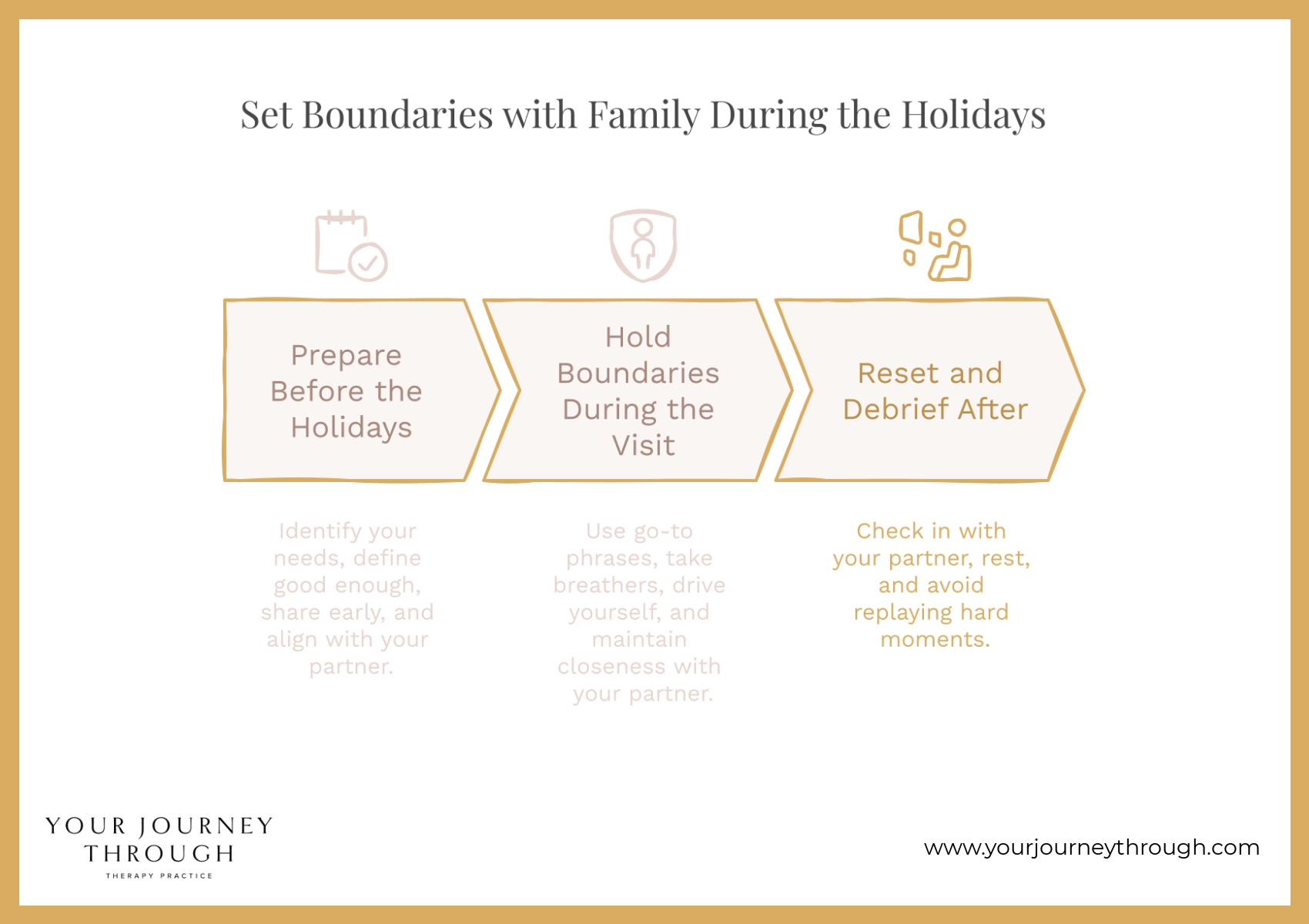
During: Hold Your Boundaries with Family During the Holidays
Keep a go-to phrase ready.
Step out for a breather: a walk, the porch, the car.
Drive yourself, and know your exit time.
Build in moments of closeness with your partner, like a quick check-in, a code word, or a walk together. You're a team.
A short line you can repeat beats a debate every time: "That's not something I'm discussing today."
After: Reset and Debrief
Check in with your partner. What worked? What's one thing to change next time? Then rest with sweatpants, snacks, and some real quiet. Feeling wiped out after a big gathering? That is the introvert hangover, and it is normal.
Try not to replay the hard moments on a loop. Every gathering is practice, not a pass/fail test of your boundary setting.
If holiday tension is spilling into your relationship, read more about stress in relationships.
Boundary Scripts: Your Holiday Survival Guide for Common Family Situations
Knowing you need to set a boundary is one thing. Finding the words is another. Here are some to borrow.
| Situation | Boundary | What to say | |
|---|---|---|---|
| Unsolicited parenting or life advice | Your choices are yours | “Thanks for caring. We’ve got this one handled.” | |
| Questions about weight, kids, money, or career | Some topics are off-limits | “I’d rather not get into that. How’s your new job going?” | |
| Pressure to stay overnight | You choose where you sleep | “We’re staying at a hotel so everyone gets some breathing room.” | |
| Splitting time between families | A schedule you can keep | “We’ll be with you Christmas Eve and with Sam’s family Christmas Day.” | |
| Conflict fueled by alcohol | You leave tense moments | “I’m going to call it a night. Love you all.” | |
| Gift or spending expectations | A budget that fits | “We’re keeping gifts simple this year. Want to draw names?” | |
| A relative criticizes your partner | Your partner is off-limits | “Please don’t talk about Alex that way. I’m on their team.” | |
| Last-minute changes to plans | Plans that are already set | “That won’t work for us today. Let’s plan it for next time.” |
Make these your own. Keep them brief and warm. Politics at the table? Our guide to balancing politics and mental well-being can help you stay steady.
Scripts for Boundaries with Family Members: Parents and In-Laws
"I know you want the best for us. We've decided, and we're sticking with it."
"I hear you. We'll keep doing it our way."
If the in-law is your spouse's parent, let your spouse take the lead with their own family. Back them up with ‘we’ language so no one is positioned as the problem.
Scripts for Siblings and Boundaries with Extended Family
Old sibling roles can come right back at family gatherings. Try lines like these:
"Ha, still no update there! Pass the potatoes?"
"We always end up arguing about this. I'm sitting this one out."
What do I do when someone gets mad at my boundaries?
Stay steady. Acknowledge their feelings without giving in, restate your boundary calmly, and give them time. Their reaction isn't proof that you did something wrong.
What to Do When Family Pushes Back on Your Boundaries
Pushback is common when the rules change. It doesn't mean the boundaries you've set are wrong. As Mental Health America puts it, we can't control how other people act. What we can control is "how we respond when someone chooses not to respect a boundary."
Stay Calm and Repeat Yourself
Use the "broken record" approach. Restate the boundary once, kindly, and skip any new arguments. The Depression and Bipolar Support Alliance puts it plainly: "You don't need to justify, defend, or apologize for your boundaries."
Escalate Gently When a Boundary Is Ignored
Restate: "Like I said, I'm not discussing that."
Name the consequence: "If it keeps coming up, I'll head out early."
Follow through: Leave the room, shorten the visit, or end the call.
A consequence is about what you will do. A punishment tries to control someone else. Stick to consequences.
When It Feels Like Too Much: Toxic or Painful Family Dynamics
Some family dynamics need more support than a script can give. A therapist can work alongside you to sort out patterns, practice your wording, and decide what feels right for you, whether or not anyone gets a "toxic family" label. If this feels heavy, support is available.
If you ever feel unsafe, or someone is in crisis, you can reach the 988 Suicide and Crisis Lifeline any time. By calling or texting 988, you'll connect with mental health professionals.
What are some consequences for crossing boundaries?
A consequence is something you do to protect yourself, not something you do to someone else. Think leaving the room, shortening a visit, ending a phone call, or skipping a future event. Name it calmly ahead of time, then follow through.
Get Support with Family Therapy in Raleigh, NC and Online
Boundaries with family are easier to hold when you have a place to practice them. At Your Journey Through, family therapy in Raleigh, NC and virtually gives you and your family space to work on communication, expectations, and the boundary conversations this guide covers. We also offer individual therapy and couples therapy, whether you want support on your own or as a team with your partner.
Sessions are available in person at our Raleigh office and online across North Carolina. They suit anyone who wants help with family communication and boundaries. To talk through which option fits you, schedule your free consultation here.
